Wednesday, 12 December 2012

Retro Rangliste - Euro 80

Goalkeepers

Harald Schumacher (West Germany) 4 games, 0 goals **
Dino Zoff (Italy) 4 games, 0 goals *
Jean-Marie Pfaff (Belgium) 4 games, 0 goals *

Full-backs

Manfred Kaltz (West Germany) 4 games, 0 goals **
Eric Gerets (Belgium) 4 games, 1 goal **
Claudio Gentile (Italy) 4 games, 0 goals *
Michael Renquin (Belgium) 4 games, 0 goals *

Centre-backs

Gaetano Scirea (Italy) 4 games, 0 goals **
Karlheinz Forster (West Germany) 4 games, 0 goals **
Uli Stielike (West Germany) 4 games, 0 goals *
Ruud Krol (Netherlands) 3 games, 0 goals *
Dave Watson (England) 3 games, 0 goals *
Fulvio Collovati (Italy) 4 games, 0 goals *

Central midfielders

Hans-Peter Briegel (West Germany) 4 games, 0 goals **
Jesus Zamora (Spain) 3 games, 0 goals *
Juan Manuel Asensi (Spain) 2 games, 0 goals *
Marco Tardelli (Italy) 4 games, 1 goals *

Attacking midfielders

Wilfriedvan Moer (Belgium) *** 4 games, 0 goals
Bernd Schuster (West Germany) 2 games, 0 goals **
Hansi Muller (West Germany) 4 games, 0 goals *

Forwards

Karl-Heinz Rummenigge (West Germany) 4 games, 1 goal ***
Jan Ceulemans (Belgium) *** 4 games, 1 goal

Strikers

Horst Hrubesch (West Germany) 3 games, 2 goals *
Klaus Allofs (West Germany) 3 games, 3 goals *
Zdenek Nehoda (Czechoslovakia) 4 games, 2 goals *

World Class
1.      Karl-Heinz Rummenigge
2.      Jan Ceulemans
3.      Wilfried van Moer

Ratings
World Class *** – Performing consistently to an exceptional standard. Among the finest players in the world and performing at a level comparable with the very best in your position.
International class ** – Performing consistently to an excellent or sporadically to an exceptional standard. 
National class * – Performing consistently to a very high standard or sporadically to an exceptional or excellent standard.

Friday, 26 October 2012

A History of World Football in 100 Games - Part 28


Brazil 1-2 Uruguay (16 July 1950) Maracana, Rio

From its earliest days the organisation of the World Cup was always chaotic. The finals of 1950 in Brazil proved to be no exception. Moving decisively away from the straight knock-out format which has made up the 1934 and 1938 editions, this time there were to be no knock-out games at all. Instead the winners of four groups would meet in a final pool to determine the winner. There wouldn’t even be a final!

The haphazard nature of the format was made worse by the decision of numerous teams not to attend. Scotland had the option to take part but declined, as did France, Czechoslovakia and Turkey. The most notable absentees were Argentina, who still had an array of talent at their disposal, and could hardly blame the distance for their decision to refuse. Felix Loustau, Jose Manuel Moreno and Alfredo Di Stefano would all miss out on the chance to compete at a World Cup thanks to that decision.

Fortunately for South America, hosts Brazil appeared to be able replacements. Argentina had missed the 1949 Copa America due to a player’s strike, and in their absence Brazil had demolished the field. Beating Ecuador 9-1 and Bolivia 10-1 may have seemed simple feats, but a 5-1 destruction of Uruguay boded well. Their only defeat in the tournament came to Paraguay, who achieved a shock 2-1 victory, only for the Selecao to gain revenge three days later with a thumping 7-0 win.

The form of the hosts in the build up to the tournament had been slightly less positive. Mini tournaments were arranged with both Uruguay and Paraguay to prepare for the World Cup, and while Brazil edged both of those series they had not been as comfortable as the Copa America. Uruguay had recorded a 4-3 win over Brazil in Sao Paulo, before suffering two narrow reverses in Rio.

The unquestioned strength of the Brazilian line-up lay with their inside-forward trio of Ademir, Jair and Zizinho. At inside-left was Jair, a converted winger, referred to by the Italian press as un fronzoliere (slingshot man) in recognition of his dangerous shooting. The centre-forward was Ademir, a prolific goalscorer known as “the chin” in recognition of his prominent jawline. The star, unquestionably, was Zizinho. The idol of a young Pele, he epitomised what is today regarded as the Brazilian style of football, with his mazy dribbles and defence splitting throughballs.

Zizinho was injured for the hosts’ opener against Mexico, a game in which the 4-0 scoreline didn’t really do justice to the level of dominance the Selecao enjoyed. With the Maracana not fully finished ‘only’ 80,000 spectators packed in to see Ademir and Jair torment the Mexican defence, this time ably assisted by Baltazar. Mexican goalkeeper, Antonio Carbajal, was appearing in the first of a record five World Cups, but he rarely had a busier day at the office, with his goal under constant siege.

The second group game almost proved to be Brazil’s undoing as they made a series of changes, including leaving out Jair and centre-half Danilo. As a result they only scraped a draw against Switzerland who grabbed a last gasp equaliser from Jacky Fatton to put the hosts’ hopes of progression in doubt. Comprehensive victories over Switzerland and Mexico had put Yugoslavia in pole position, and with only one team progressing from the group, Brazil would need a win if they were to avoid early embarrassment.

Yugoslavia were not a team to be taken lightly. Not only had they impressed in their opening fixtures, they had also finished runners up to Sweden at the 1948 Olympics, and they could boast many of the game’s finest players. Zlatko Cajkovski was a tremendously versatile footballer, primarily a half-back but capable of operating comfortably in almost any position. Meanwhile, up front the Yugoslavs had two of Europe’s most talented forwards in Stjepan Bobek and Bernard Vukas. If Brazil underestimated them as they had the Swiss they had little chance of progression.

This time due respect was shown. Brazil recalled Jair and, though not fully fit, Zizinho was added to the line-up. The changes quickly paid dividends for Flavio Costa’s team as they took the lead after just three minutes through Ademir. Midway through the second half Zizinho settled the match as he picked the ball up from a throw in, beat a static Yugoslav defense and rifled the ball in from the six yard box. According to Eduardo Galeano the goal was an exact replica of one “Mestre Ziza” had scored moments earlier, but which had been erroneously ruled out by the referee.

In the final group stage Brazil began against Olympic champions Sweden, though this was a shadow of the side which had won gold in London. The Swedish FA did not permit the selection of foreign based players, ruling out the inclusion of Gunnar Gren, Gunnar Nordahl and Nils Liedholm (the fabled “GreNoLi” trio) who had moved to Milan. As a result the game was an utterly one-sided affair, with Brazil completing a 7-1 rout. Ademir was at his potent best, scoring four times, while Chico bagged two.

Spain, who had done for England’s hopes, were similarly dispatched with ruthless efficiency. A team with supreme wingers in the shape of Basora and Gainza, an excellent centre-forward in Zarra, and a fine goalkeeper in Ramellets, they lacked the defensive mettle to contain Brazil’s inside-forwards. Contention still exists over whether Ademir scored two, one or none in this game (most sources settling on one), but Spain were 3-0 down at half-time and a full-time score of 6-1 was a fair reflection of the run of play. This time all three of the great trio ended up on the scoresheet, with Chico also recording another brace.

Uruguay’s World Cup journey had been markedly shorter. With only 13 teams in the tournament they had been placed in a group with just one opponent, Boliva, who they demolished 8-0 to progress to the final pool. A 2-2 draw with Spain and 3-2 win over Sweden, meant they now had to beat Brazil if they were to capture a second World Cup crown.

Few locally felt there was much chance of that, but the image of Uruguay as plucky no-hopers battling against the might of Brazil is built squarely on later events. The Celeste were eight time South American champions (compared with Brazil’s three) with a faultless World Cup record. They also possessed arguably the finest inside-forward in the tournament (yes, better even than Zizinho) in Juan Alberto Schiaffino, and the world’s best right-half, Victor Rodriguez Andrade, the nephew of 1930 World Cup winner Jose Leandro Andrade. Uruguay were a team of pedigree, even if their recent results against Brazil were unfavourable.

The match was played in front of a crowd of over 200,000, the largest in history, anxiously expecting a Brazilian victory. The home side had much the better of the early exchanges with Uruguay content to keep the game tight. Defending manfully was Uruguayan skipper, Obdulio Varela, known as “El Negro Jefe” (“the black chief”) because of his command of the game. It was not until early in the second half that the long awaited Brazilian breakthrough came. Ademir and Zizinho combined to release Friaca, and the winger’s shot beat Maspoli in the Argentine goal.

As the stadium erupted one man stayed calm. Obdulio Varela took hold of the ball and refused to restart the game until a cacophony of boos and cat-calls erupted from the home crowd. The atmosphere turned from one of euphoria to one of anger, just as Varela had wanted. Minutes later Ghiggia centred for Schiaffino, and the Uruguayans were level. A draw would still see Brazil crowned as world champions, but the nervousness of the crowd was permeating through to the players. With ten minutes remaining Ghiggia was released and his cool finish past Barbosa gave Uruguay a decisive lead.

The reaction within Brazil was one of national mourning. Some fans were moved to commit suicide, such was the level of disappointment. The spectre of the defeat still hangs over Brazilian football today with question marks remaining over whether the ghosts of the Maracana can be exorcised in 2014. Uruguay meanwhile were World Champions again and the tiny speck on the map had triumphed over their enormous neighbour.
  

Thursday, 25 October 2012

Why English football doesn’t need a “Rooney rule”


As English football reels from one race crisis to another, an unprecedented level of focus has been centred on discrimination within the game. With the spectre looming of a breakaway black players union the PFA’s chief executive, Gordon Taylor, yesterday set out the organisation’s six point plan to combat racism. Clearly the PFA has been put on the back foot by the John Terry and Luis Suarez scandals, along with the recent protests from leading black players against the lack of influence enjoyed by the “Kick it Out” campaign.

Given the speed with which the FA has had to respond it’s not surprising that some of their proposals are ill thought out. While racism in football has been an issue for numerous years it is really the threat of a rival union for black players which has forced their hand. Yet surely it is better to respond with something that actually improves the status quo than rashly come up with a set of proposals as a sop to public sentiment?

The most headline grabbing of their proposals is for the introduction of an English “Rooney rule” to increase the number of black managers within the game. In 2003 the NFL introduced such a rule (named after Pittsburgh Steelers owner Dan Rooney) to mandate that black or ethnic minority candidates were interviewed for the position of head coach and senior football operations opportunities if they became available. The result was that the proportion of black head coaches at NFL teams increased from 6% to 22% within just three years.

In England, the argument goes, black players make up 20-25% of those in the football leagues, and yet only four managers (Chris Hughton, Chris Powell, Keith Curle and Edgar Davids) are drawn from ethnic minorities. As such the suggestion is that black managers are effectively underrepresented and the PFA wants to encourage more black players to have the opportunity to coach at the highest level.

Unquestionably under the current method of recruitment almost solely from the pool of ex-professional players, ethnic minorities are grossly underrepresented. Yet this highlights the bizarre nature of management appointments in this country. As Arrigo Sacchi pointed out in relation to his questions over his own managerial credentials. "I never realised that to become a jockey you needed to be a horse first."

The requirements of a football manager and a footballer are starkly different. One is focused on physical and athletic gifts, the other places demands on motivational, tactical and analytical attributes. There is naturally an overlap between them, but one only needs to look at the number of exceptional players who made mediocre (at best) managers to see that ability in one field is far from a guarantee of success in the other.

Despite the seemingly far removed skillsets only Lennie Lawrence (the newly appointed caretaker manager of Crystal Palace), Russell Slade (of Leyton Orient), and Andre Villas-Boas did not play professionally among football league managers. Of these, Villas –Boas got his first opportunity in Portugal (a league in which a lack of playing experience is no barrier to progression), while Slade and Lawrence have both scrapped their way around the lower leagues with little hope of elevation. At the highest level this predilection with playing experience is even more pronounced. Of the nine managers appointed at Premier League clubs in the last 12 months, seven had themselves played the game in the top flight (though not all in England).

Even among those who did play professional football, relatively few did it at the highest level. David Moyes and Arsene Wenger both had playing careers which were modest in comparison with their exploits as managers. Alex Ferguson’s disappointment at his Rangers career has often been seen as providing him with an additional point to prove when he moved to coaching. Brendan Rodgers (like Brian Clough before him) saw his career cut short, an unwelcome event that ultimately gave him greater time to study the game.

Meanwhile English football continues to ignore the vast numbers of people who lack playing experience, but who could make a major contribution. In addition to Sacchi and Villas-Boas, the likes of Jose Mourinho, Carlos Alberto Parreira and Zdenek Zeman were able to forge exceptionally successful managerial careers despite not playing the game. Given the dearth of promising English managers it’s clear to see that football is shooting itself in the foot by overlooking a whole section of society.

The reason for this obsession with playing experience is obvious. When a club appoints Bryan Robson or Graeme Souness it is almost impossible for fans to disassociate the middling manager from the aura that his decorated playing career carries. Given the tendency for fans to be won over by short term and populist appointments it takes a brave chairman to give an opportunity to an untried manager who is not a big name. British chairmen are happy to appoint the likes of Mourinho and Villas-Boas once they have proven themselves at a giant like Porto, indeed they are willing to pay large release clauses to do so, but o far at least they have been decidedly less brave in seeking to unearth their own “special one”.

To expect the PFA, a trade union representing the interests of the players alone, to suggest ending the arcane practice of hiring solely from their members is also silly. They have a duty to act in a way that benefits their members, regardless of whether that also improves the fortunes of football as a whole. But that self-serving raison d’etre also makes some of their claims rather hollow.

The idea of introducing a “Rooney rule” might seem a panacea to cure football of its current ills. Yet in reality it would simply paper over the fundamental flaws which beset the entire process of appointing managers. England does not just lack a reasonable number of black managers within the football league, it lacks a sensible method of unearthing managers of talent, regardless of their ethnicity.

Rather than a requirement to interview members of ethnic minorities, a far more inclusive amendment would be to interview prospective managers of any race who had not previously held a professional position. That would not only open up the field to members of all ethnicities, it would end the “old boys’ network” that sees failing managers bounce around from club to club based on a long past playing career. Sadly in their attempt to take control of the media agenda, the PFA have instead latched on to another half-baked idea that will benefit nobody.

Wednesday, 10 October 2012

Jozsef Bozsik - Hungarian Rhapsody


Among the most widely noted tactical phenomena of the last ten years has been the increasing importance of the “deep lying playmaker”. As teams have lined up with ever more defensive midfielders, previously advanced midfielders have dropped ever deeper themselves in search of precious space. In many ways this isn’t a new trend, but simply a return to a practice of the 1950s and earlier. For prior to the advent of the WM, the deep lying playmaker (such as Austria’s attacking centre-half, Ernst Ocwirk) was a mainstay of the game.

Arguably the finest deep lying playmaker in football history was Hungary’s stellar right-half, Jozsef Bozsik. When the Magical Magyars are fondly remembered, it is often for the goalscoring exploits of Sandor Kocsis, the tactical innovations of Peter Palotas and Nandor Hidegkuti, and the all round brilliance of Ferenc Puskas. The result is that the metronomic qualities of Bozsik are frequently overlooked.

Born in the Kispest area of Budapest, Bozsik (nicknamed “Cucu” by his grandmother at an early age) developed a life-long friendship with Ferenc Puskas from the age of five and the two would go on to form arguably the most fruitful footballing partnership in history. At 11 years old Bozsik was selected by Nandor Szucs to join the junior section of the Kispest Football Club, a team he would never leave.

He was not the only Bozsik to be spotted by the club. Jozsef shared a bedroom in the family’s tiny Budapest house with his four brothers, all of whom represented Kispest, in either the senior or junior teams. None though possessed the talent or the dedication of Jozsef.

Indeed, the young Bozsik made his debut for Kispest against Vasas at the age of just 17, but following the game was dropped and it took him some time to get back into the team. By the end of 1943 Puskas had made his debut for Kispest, and soon Bozsik was back in the team. From then on he never relinquished his place.

In the early years it was Puskas who blossomed first, winning his first cap in 1945, while Bozsik was forced to wait until 1947 when he made his debut in a 9-0 victory over Bulgaria. At the beginning of his career in Hungary few appreciated what Bozsik brought to the game. Lacking pace, many considered him to be ponderous on the ball and too slow to play for the national team. With time though observers began to realise that rather than make a wrong decision quickly, Bozsik took his time to get it right.

By the stage that he made his debut for the national team it was apparent that Bozsik’s decision making was one of the central strengths to his game. Not only was he able to spot the right pass at the right moment, his technique was impeccable. The youngster possessed a range of passing that allowed him to find distant targets, but he was also happy to play the simple ball if it meant retaining possession. Furthermore, he was almost impossible to dispossess as he shielded the ball so well from opponents.

In May 1947 Kispest set off on a tour of France and Luxembourg. The play of Bozsik caught the eye of many watching, and the club received an offer of 2 million Francs, which was immediately rebuffed. Bozsik was not the only player to receive offers from foreign teams but the government were unwilling to allow the country’s best players go abroad for fear of the impact it might have on the national team.

Kispest at the time were far from the biggest club in Hungary. Budapest giants Ferencvaros and MTK had far greater resources at their disposal, while the country’s form team were Ujpest. In order therefore to retain their two star players, Kispest gave a local ironmonger’s shop to Bozsik and Puskas. The pair considered themselves rich at the time, but within a matter of months the government embarked on a programme of nationalising small businesses and the shop was no more.

However, while government intervention was detrimental to the finances of Puskas and Bozsik, it had only positive effects on their footballing career. The conversion to communism that took place in Hungary in 1949 saw Kispest become the chosen team of the army. The following years saw the likes of Lazslo Budai, Zoltan Czibor, Gyula Grosics and Sandor Kocsis arrive at the club as they swept up most of the nation’s finest players.

The change in stature of the club almost immediately yielded results on the pitch. Now renamed Honved, the team won the title in 1949-50 and began a period of domestic domination. Despite the arrival of the other great players at Honved, the pair of Bozsik and Puskas remained central to the team’s success. When Bozsik received the ball in his right-half position, his first thought was to try and play a cross-field diagonal pass to find Puskas at his typical inside-left. The source of so many of the goals scored by Puskas was this searching and unerring pass.

One man who held Bozsik in particularly high regard was Puskas’ father, also called Ferenc. He coached Honved in two spells, sandwiched around a brief period where the great Bela Guttmann took charge. If ever Puskas wanted to convince his father of something he would say, “Ask your friend Bozsik, he will tell you I’m right.”

As the team became affiliated with the army, Bozsik was enrolled as an officer. Fortunately for him that entailed very little true soldiering. For his first three months in the army he was forced to live in barracks, but after learning the basics of marching and parades he was allowed to return home. Soon after his move to the barracks he was, along with Puskas, promoted to the rank of lieutenant but after just 18 months in the army even the requirement to report for training was dropped.

As Honved began to improve as a club, so too did Hungary as a nation. In the pre-war years the Danubian school of football had been at the forefront of the game, and Hungary had reached the World Cup final of 1938. Now the national team again became among the most feared in football.

Following Bozsik’s debut for Hungary in 1947 they set off on a run of results which saw them win ten of their next 14 games, including three consecutive 5-0 victories over Bulgaria, Sweden and Czechoslovakia. A 5-3 defeat away against Austria was a setback, but they immediately resumed their winning sequence. By the time they reached the 1952 Olympics in Helsinki, they had won nine of their last ten games, with the other a draw. In Finland the team continued their exceptional form, thrashing Italy, Turkey and Sweden before beating a fine Yugoslavia team 2-0 in the final.

One of the results of Hungary’s exceptional performance at the Olympics was the opportunity for a friendly with England. Following the 6-0 demolition of Sweden in the semi-finals, Stanley Rous, the secretary of the FA, proposed the two teams might meet at Wembley. The result, of course, was an historic 6-3 victory for Hungary, the first Continental team to win at Wembley.

The match was famous for many things: England’s first ever defeat at home to “foreign opposition” (the Republic of Ireland had beaten them at Goodison Park in 1949), the remarkable “drag-back” goal of Puskas, but most of all for the maelstrom caused in the English defence by the movement of Nandor Hidegkuti. Many players were to profit from the confusion the English defenders showed, but the man it was intended to benefit most was Jozsef Bozsik.

With Hidegkuti pulling players out of their natural positions, space was constantly available to Bozsik. Given his ability to choose the right pass when placed under even the greatest pressure, he was in his element when allowed free reign. Indeed in many ways it was Bozsik who set the tone early on. Within fifty seconds of the game kicking off it was Bozsik’s pass that put Hidegkuti through to score. Later on in the match Bozsik scored the fourth goal of the game with a deflected free-kick. Certainly Hidegkuti and Puskas more than deserved the plaudits, but Cucu played his part. 

A year later the team prepared for the 1954 World Cup. As well as beating England at Wembley they had humbled the game’s inventors 7-1 in Budapest, in addition to beating Italy 3-0 in Rome in 1953. In short, they were widely considered invincible. The two group games of the World Cup showed why many held that opinion, as South Korea were dispatched 9-0 before West Germany were beaten 8-3.

Those victories set up a quarter-final with Brazil that came to be known as the Battle of Berne for the levels of violence displayed. Bozsik was a naturally placid character, but that was not always the case when playing football. Puskas would later reflect, “He never seemed to get excited, just didn’t show it at all. Off the pitch, I don’t think I ever saw him angry, but on it, if someone had clobbered him off the ball, he could break into a rage and threaten to leave the field.”

By 1954 Brazil had established themselves as a genuinely world class team and were putting up far greater resistance than those who had gone before them. Hungary had raced into a two goal lead, but Brazil fought back and with 20 minutes remaining the score stood at 3-2. Nilton Santos, a defender so complete that he was nicknamed the “Encyclopaedia of Football”, then flung himself into a reckless tackle on Bozsik which brought on the rage Puskas referred to. The two players traded punches and were immediately dismissed by English referee Arthur Ellis. 

In Bozsik’s absence the Hungarians prevailed and Cucu was able to return for the semi-final against defending champions, Uruguay. Arguably the finest game in the history of the sport saw two supreme attacking sides take it in turns to threaten the opposing goal. Hungary seemed certain winners at 2-0, but Uruguay fought back to force extra-time. Kocsis restored the Hungarian advantage before applying the killer blow with a header from Bozsik’s cross. The final against West Germany saw Puskas return from injury, but Hungary again allowed a two goal lead to slip away. This time it would be West Germany who would prevail.

The defeat was a tremendous anticlimax for a team that seemed sure to win. Hungary had not lost a match for four years since their defeat to Austria in Vienna, recording 27 victories and four draws in the intervening years. To lose the match that mattered most was a crushing disappointment. Yet almost immediately the team started winning again. It was not until 1956 that they would lose another game.

That was the year of the Hungarian revolution which prompted the break up of the “Golden Team”. When the uprising took place Honved were abroad as they prepared to take on Athletic Bilbao in the European Cup. The team had been scheduled to depart on a tour of South America, and although the tour went ahead it did so without the permission of the Hungarian authorities. When it finished the players were faced with a difficult decision: should they return to Hungary or remain in exile?

Bozsik’s position was among the most difficult. He was not only a member of the Communist party, he was also a deputy in the Hungarian parliament. Furthermore, his father had recently died and he did not feel he could abandon his mother and four brothers in Budapest. The chance to coach at Atletico Madrid (an offer obtained for him by Emil Osterreicher) was tempting, but he could not fail to return home.

As he did so both Honved and the Hungarian national team fell apart. Czibor, Kocsis and Puskas, all decided to stay in the West and in their absence the club was no longer competitive. Despite that, Bozsik remained. A disappointing World Cup in 1958 did not deter him from captaining the Hungarian national team and in 1961 he became only the third man in history (after Billy Wright and Thorbjorn Svenssen) to reach 100 caps.

Given his lack of goalscoring prowess and the limited availability of footage it is perhaps inevitable that the name of Bozsik has largely been forgotten. Yet there are few historical players who would have been more valued in the modern game. For Bozsik possessed the gift that is the most valued in contemporary football and the hardest to find, that of time. He had the ability and composure to wait for the right option and to execute what few others could even see. In an era where such qualities are at a premium, Bozsik would have been peerless.   

Thursday, 19 July 2012

Time for Wayne Rooney to take his place among the greats


As footballing comparisons go, they don’t get much bigger. To be touted as the second coming of the game’s greatest ever player is some burden, especially for an 18 year old. That Roy Hodgson chose again to invoke the name of Pele when talking about the potential impact of a man suspended for the first two games of the European Championships shows both the high regard in which Wayne Rooney is held and the dearth of other striking options.

Rooney has had to live with such lofty expectations since his earliest steps in the footballing limelight. Elevated to superstar status before he reached the age of majority, there are few who have grown up under such scrutiny. Both on and off the pitch he finds his life subjected to microscopic analysis. Now though is the time for the England forward to finally show what he is all about.

2011-12 was, in Premier League goalscoring terms at least, Rooney’s most productive season in his short career despite the inconsistent (by their high standards) form that Manchester United showed. That should, in theory, suggest that Rooney is about to embark on another golden campaign but his form at the Euros gave little indication that he was ready to step up. Admittedly, he missed the first two games of the tournament, but his conditioning looked woefully short of the required standard given that he had been suspended rather than injured.

Of all the players to travel to Ukraine only Ashley Young and James Milner were more underwhelming than Rooney, and they at least had the excuse of being constrained by the rigid tactics which had been imposed by Roy Hodgson. Rooney, of course, scored  a crucial goal in the victory over Ukraine (how could he miss?), but his failure to link midfield  with attack left some questioning whether he really is the “world class” forward that he is so often touted as.

Unquestionably Rooney has the attributes to succeed at the highest level. He remains a fabulously instinctive striker and has improved on a number of the perceived weaknesses which used to blight his game. Rooney’s much talked about disciplinary problems appeared a thing of the past last season with a solitary yellow card the only stain on his record. For so long critics suggested that by taking away his tempestuous nature you would effectively neuter the young forward, yet he proved categorically that he can be at his best without that side to his game

Meanwhile, whether due to his own hard work or to the fine crossing of Antonio Valencia, Rooney’s heading ability has now caught up with the dexterity demonstrated by his right boot. When United suffered an injury crisis he was able and willing to slot into central midfield and evidenced why many regard him as a frustrated playmaker. That willingness to focus on particular footballing deficiencies has been paramount in Cristiano Ronaldo’s elevation to greatness. If Rooney can do the same could he catch the Portuguese?

The last time Rooney enjoyed such a prolific season in front of goal was prior to the 2010 World Cup. Then injury against Bayern Munich curtailed a wonderful vein of form, and seemed to weigh heavily on the United striker in South Africa. The following campaign saw Rooney struggle in the opening stages of the season, before finally coming good as the fixtures got interesting. Rooney simply cannot afford to allow such a lengthy hangover this time around.

For with his 27th birthday rapidly approaching, now is the time for England’s talisman to justify the hype. Regarded for years as among football’s elite group of top players, he needs to kick on from last year’s heroics with another season of the same calibre. While few genuinely believed the Pele comparisons there was certainly an expectation that Rooney would be a player capable of challenging for the Ballon D’Or. His fifth place in 2011 was his highest placing yet, but in a year where many of the most legitimate contenders (Robin Van Persie, David Silva, Thiago Silva for instance) failed to even make the 23 man shortlist, and where Rooney picked up just 2% of the vote, it was a slightly hollow achievement.

Admittedly, competing with Lionel Messi and Cristiano Ronaldo is not easy. Yet what sets them apart from their rivals is not just the fabulous array of talents that they possess but the unrelenting consistency with which they apply them. Both have now put in a series of seasons operating at an “all-time” level. In contrast Rooney’s fitful brilliance is what has impeded his elevation to their level. To join them in the halls of football’s pantheon Rooney must now seek to emulate that unyielding desire for improvement. If instead he allows another precious year slip away he risks being remembered as a Premier League great rather than one of the world’s finest players. The decision is surely up to him. 

Tuesday, 17 July 2012

A History of World Football in 100 Games - Part 27


 USA 1-0 England (29 June 1950) Independencia, Belo Horizonte

English football history is littered with false dawns. While the national team often suffered setbacks they were quickly forgotten and the air of invincibility was swift to return. After the humbling from the Wembley Wizards and the defeat in Spain of the late 1920s there were morale boosting victories over Austria and Italy to reaffirm the pre-eminence of the English game.

By the late 1930s defeat abroad had become almost commonplace, but victories at home ensured that few saw anything deeply wrong in domestic football. When peacetime returned in 1945 a similar pattern emerged. England were frequently tested and occasionally beaten (away in France in 1946 and Switzerland in 1947), but their form and quality were hard to judge.

On occasion England were able to produce performances that did suggest they could be world beaters. An 8-2 annihilation of Holland in a friendly perhaps pointed more to their international standing at the time than England’s attacking prowess, but the 10-0 destruction of Portugal in Lisbon was a result to be respected. The most impressive of all the post-war friendlies (indeed arguably the most impressive single result England have ever recorded) was a 4-0 win over Italy in Turin. With an Italian side packed full of Torino stars, England were ruthless and took their chances clinically.

A fact recognised more in hindsight than at the time was the introduction of a dedicated England manager. While the players were still selected by a committee, Walter Winterbottom now had the task of shaping them into a team. That was a challenge that was easier said than done given the focus within English football remained squarely on the individual, rather than the collective. Moreover the committee which selected the team, did so with little or no regard for how they might combine together, complicating Winterbottom’s job still further.

Walter Winterbottom
England were though blessed with a number of excellent individuals. Stanley Matthews was well into his thirties, but still possessed the rapid acceleration and body-swerve which had eluded defenders since the 1930s. Tom Finney was as complete and versatile an attacker as England ever produced and was capable of playing in any position across the front line. Tommy Lawton remained the ideal centre-forward for such a pair of wingers, commonly regarded as the finest header of a ball that English football has witnessed. To then be able to call on inside-forwards such as Wilf Mannion of Middlesbrough and Matthews’ colleague at Blackpool, Stanley Mortensen, left Winterbottom in an envious position.

The return of the Home Nations to FIFA following World War II, opened up the opportunity of participating in the 1950 World Cup. The Home Championship was designated as a World Cup qualifying group with the top two teams allowed to travel to Brazil. While international relations had improved since the pre-war era, Scotland decided that they would only travel to the finals if they ended up as the winners of the Home Championship. As it was after beating Wales 4-1 in Cardiff and Northern Ireland 9-2 in Manchester, England travelled to Hampden Park for the deciding game. Scotland were narrowly beaten 1-0 courtesy of a Roy Bentley goal that ensured it would be England making the trip to South America.
 
England’s World Cup preparations started smoothly. They warmed up for the tournament with a 5-3 win against Portugal and a 4-1 victory over Belgium, both away from home. Yet there were clear signs that a characteristic lack of focus was in place. England travelled to Brazil with just one member of their selection “committee”, Arthur Drewry, alongside them. The FA also sent Stanley Matthews off on an unnecessary tour of Canada which meant he missed the first game of the tournament.

Wilf Mannion

Despite these complications England enjoyed a relatively straightforward victory in their opening group match against Chile. Goals six minutes either side of half-time from Mortensen and Mannion were enough to secure the win, though Chile twice struck the frame of the goal. With that hurdle vaulted England faced what appeared to be a formality for the second group game, this time against the USA.

When compared with England the USA were a marked contrast in both World Cup pedigree and current quality. As semi-finalists in 1930 the Americans were in one respect the side with experience on their side, but in terms of the players they took to Brazil they couldn’t hold a candle to England. The demise of the first American Soccer League had weakened the strength of the domestic game and a 3-1 defeat to Chile in their opener pointed to a side that England might expect to beat. Manager Bill Jeffrey, a Scot, appeared to anticipate the worse when he said before the game “We ain’t got a chance against your boys.”

Quite how one sided the match was remains an open question. Most match reports suggest that England besieged the American goal, hitting the woodwork on a near constant basis and drawing save after save from Frank Borghi. In reality it appears to have been far closer, with England enjoying the majority of possession and chances but vigilant to the US threat.

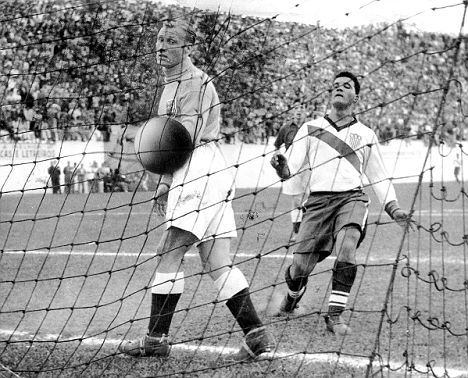
With half-time rapidly approaching the Americans accomplished the unthinkable and scored. A wild shot from Walter Bahr (occasionally referred to as a clearance) was diverted into the net by the Haitian born Joe Gaetjens and England found themselves behind. Many would later suggest that Gaetjens contribution to the goal was inadvertent (Alf Ramsey suggested he was trying to duck), but Bahr was insistent that it was a deliberate and brilliant diving header.

Joe Gaetjens
In the second-half England thought they had levelled through Mullen’s header, but the referee judged the ball had not crossed the line. Earlier Tom Finney had hit the post, and England also went close through Mortensen but they remained incapable of finding an equaliser. Defeat to the USA should not have been fatal, and victory against Spain in the final group match would have sent England through. Instead they went down 1-0 to a goal from the legendary goalscorer Telmo Zarra. England’s first World Cup adventure ended in ignominy.

Somewhat typically the reaction to this failure at home was rather less apocalyptic than the modern reader might expect. Just as with the defeat to Spain and the continental reverses that followed the fact that the humiliation took place abroad, far away from home, meant that it was out of sight and largely out of mind. It would take more than this setback to shake England’s faith in their position among the world powers. 

Friday, 13 July 2012

Zlatan and Thiago Silva – What does it mean?


Every so often a transfer comes along which changes the landscape of football fundamentally. Johan Cruyff’s 1973 move to Barcelona, Diego Maradona’s switch to Napoli, and Luis Figo’s world record transfer to Real Madrid all represented a paradigm shift in football’s history. They marked either a clear break in an existing dynasty or the commencement of a new one. The proposed sale of Zlatan Ibrahimovic and Thiago Silva from Milan to Paris Saint-Germain may just be another example.

On the face of it the transfer doesn’t appear to be in the league of those three. For starters, all were for world record transfer fees at the time, while the Milan duo seem set to move for €65m (roughly £52m), a sum dwarfed by not only Cristiano Ronaldo’s switch to Real Madrid but also Zinedine Zidane’s departure from Juventus to join the same club. In addition Milan’s recent performance, while demonstrating a consistency in the league that was sorely lacking under Carlo Ancelotti, have hardly looked like one of the game’s great teams. PSG are themselves facing an altogether greater challenge in seeking to join Europe’s top table.

For Milan the transfer represents a quite bizarre piece of business. The club were all set to sell Thiago Silva alone to PSG for €47m just weeks ago, before a dramatic U-turn saw the Brazilian centre-back sign an improved  long term deal. To now add Ibrahimovic into the bargain for just €18m seems to represent a fire-sale. The Swede joined the rossoneri for a knock-down price of €24m just two years ago, and has only enhanced his reputation following a difficult first season at Barcelona. To now accept a loss of €6m on a player who led Serie A in scoring this season would be nonsensical.

The club are of course already undergoing a dramatic overhaul with Alessandro Nesta, Clarence Seedorf, Gennaro Gattuso, Filippo  Inzaghi and Mark Van Bommel among those who have left the San Siro. While those five all had their best years behind them Ibrahimovic and Thiago Silva are the heart and soul of the current team. Both players were outstanding in the last two seasons and proved instrumental in carrying Milan’s Scudetto challenge. The club have presented the transfers as a simple cost cutting exercise, but how costly would it be for Milan to miss out on the Champions League next season?

Replacements have been touted such as the vastly talented Dede of Vasco da Gama for Thiago Silva, and Carlos Tevez or Edin Dzeko for Ibrahimovic, but these should surely be signings to improve the existing play staff, rather than expecting them to fill in the gaps. The club pushed Juventus all the way last year, but would have been well off the pace without their two stars. With the Old Lady already having recruited Kwadwo Asamoah and Mauricio Isla from Udinese,  and speculation ongoing about the potential acquisition of Robin Van Persie, Milan are playing catch up.

Of course the transfer also has clear meaning for Serie A as a whole. The league which largely enjoyed a strangle hold over European football from the return of the stranieri in 1980 to the end of the 1990s risks being left behind. Already relegated to fourth in the UEFA coefficients, the sale of the league’s two leading foreign stars to France surely risks seeing Italian football fall still further behind that of England and Spain. Of course, this isn’t the first time a major star has decamped from Serie A. In 2001 Zinedine Zidane moved from Juventus to Real Madrid, but it was counter balanced by the arrival of Valencia’s Gaizka Mendieta at Lazio, and was part of an unprecedented transfer merry go round which saw the bianconeri acquire Gianluigi Buffon, Pavel Nedved and Lilian Thuram.

Now the league faces a drain of talent as it seeks to rectify the parlous state of club finances. Inter allowed Samuel Eto’o to depart last year in order to avoid his stratospheric wages and now talk abounds of a move for Wesley Sneijder from Russia’s free spending Anzhi. Italian clubs have struggled in recent years to attract the very top tier of international talent, but if they allow the existing stars to leave it may be impossible to replace them in the future.

Yet while the sale may be grounds for despair in Italy, it doesn’t necessarily mean that fans of French football should be jumping for joy. No club in France has acquired genuinely top class foreign talent since Marseille under Bernard Tapie in the late 1980s and early 1990s. That era saw the arrival of Chris Waddle, Dragan Stoijkovic and Rudi Voller, but it also saw the league lose its competitive edge with L’OM finishing top on five consecutive occasions. Indeed, French football has historically veered between periods of sustained dominance (St Etienne in the 60s and 70s, Marseille in the 90s and Lyon in the 2000s) and remarkable competition in a way that few other leagues have emulated.

The last five seasons have seen five different champions, yet it now seems difficult to imagine anyone stopping PSG. Champions Montpellier have already lost talismanic striker Oliver Giroud to Arsenal, though there is encouraging news over the future of playmaker Younes Behanda and left-back Henri Bedimo. The sale of Eden Hazard by Lille was largely inevitable though they have recruited well with Marvin Martin and Salomon Kalou arriving to witness a new era at the magnificent Grand Stade Lille Metropole. Marseille have already seen coach Didier Deschamps move on to manage the national team and Lyon, previously French football’s great powerhouse, are prepared to let Hugo Lloris go if the right price is achieved. In short, no side looks better placed to resist the Parisian challenge than last year.

For PSG the transfer looks likely to set in stone their domestic dominance, but surely this season’s real test will come in the Champions League. With Ezequiel Lavezzi already added to an impressive squad that includes the likes of Javier Pastore, Nene and Jeremy Menez, the club do not look likely to struggle in attack. Marseille’s 1993 success remains the only time a French club have lifted Europe’s premier trophy, and even that was achieved under the cloud of match fixing allegations which saw that season’s Ligue 1 title stripped from L’OM. If the club can now secure the capture of the game’s finest (along with Mats Hummels) centre-back and a genius such as Ibrahimovic the sky surely is the limit.

Powered by the Qatari royal family’s petrodollars Paris Saint-Germain stand on the brink of history. No French side has ever established itself as an enduring European force, yet with a manager who has already won two Champions League titles and a squad packed with some of the game’s finest talents they have the tools to mount a serious assault on football’s greatest prizes. The addition of Thiago Silva and Zlatan Ibrahimovic would certainly catapult PSG to a new level, the longer term question is what it might do to the domestic game in France.