Thursday, 21 July 2011

A History of World Football in 100 Games - Part 17

England 4-3 Austria (7 December 1932) Stamford Bridge, London

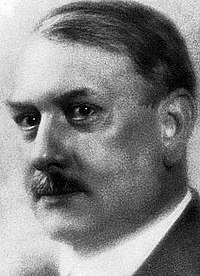
For all his many achievements as a player, referee and administrator (see part 9) Hugo Meisl will always be best known for his work as the manager of a quite incredible team. Meisl oversaw the evolution in Austrian football from taking sole charge of the national team in 1919, but it was in the early 1930s that the side established itself as a match for any in the world. It was with good reason that the Austrians became known as the “Wunderteam”.

In the years of football’s spread throughout Europe the Austrians were far from the forefront of the game’s expansion. First the Scandinavians (most notably the Danes) and then the Western Europeans pressed ahead in the race to catch up with the sport’s inventors. Yet by the time of the late 20s and early 30s, the Danubian school of Central Europe was at the vanguard of innovation within the game.

As influential as he was in the development of Austrian football, Meisl was not alone. In 1912 Meisl brought Jimmy Hogan, a former English professional, to Vienna and so began one of the most fruitful partnerships of early football history. Hogan was disaffected with the methods of training and preparation that were deeply ingrained within English football. He knew that if he was to find a more receptive audience for his ideas he would have to go and work abroad.


Jimmy Hogan
 Hogan’s first foreign coaching role was with Dordrecht in Holland and it was apparent from the start that the Continentals were naturally more open to the methods that he was attempting to impart. Hogan was an evangelist for the passing game so closely associated with the “Scottish professors”, and at Dordrecht it was this that he set about establishing, performing well enough to be asked to take charge of the Dutch national team for a game against Germany.

After Dordrecht, Hogan returned briefly to England to resume playing before moving to Vienna to work with Meisl. In Austria, Hogan and Meisl worked closely together to improve the standard of football but also to determine the best way of developing players. The pair shared a common vision of how football should best be played and the freedom afforded to Hogan allowed him to experiment with training techniques.

Hogan’s time in Vienna was cut short by WWI and by 1916 he found himself in Hungary with MTK who he formed into an exceptional side. Spells in Germany, France and Switzerland followed before in 1931 he returned to Vienna. In his absence Austrian football had altered immeasurably.

A draw for the national side with England in May 1930 had been the start of one of the greatest sequences in football history. Hungary were beaten 8-2, Switzerland 8-1, while Germany were defeated 6-0 in Berlin and 5-0 in Vienna. The result which really made the rest of Europe sit up though was the crushing 5-0 defeat of Scotland in May 1931. This was of course a Scotland team that had demolished England 5-1 at Wembley in 1928 with arguably the finest demonstration of the passing game ever seen to this point in history, yet they were comprehensively out-passed and out-played by the Austrians. The Scots were admittedly not at full strength, not selecting a single player from Rangers or Celtic (the great Davie Meiklejohn was a most notable absentee), but it still signalled a power shift in international football.

Striking as they were, these incredible results were not achieved by any form of revolution in the football played in Austria. The fundamentals that had been introduced by Hogan remained the basis for the style of play adopted by the Austrians, but by the early 1930s the technique had been perfected. Austria retained the pyramid 2-3-5 formation, but as with all the great teams they made movement an integral element to their game. When receiving the ball a player had a wealth of options available for him so that the “pass and move” style of play became simple. Such was the level of movement that the Wunderteam displayed that they came to be known as the “Danubian whirl”.


Matthias Sindelar
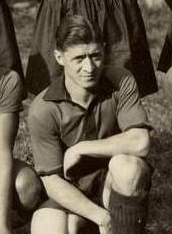
 Undeniably the focal point of this great side was centre-forward Matthias Sindelar. Known as “der Papierene” (the paper man) on account of his fragile frame, Sindelar embodied the ethos of Meisl and Hogan. He was a master of close control, demonstrated immense vision and possessed a lethal shot which skidded low and into the corner of the net. Sindelar was a genius whose ability demanded the right to roam around the field looking for the ball. Defences risked either allowing Austria an extra man in the midfield or being pulled out shape by this wandering waif.

The rest of the team were exceptional in their own right, but they fitted more neatly into the narrowly defined roles of the day. Rudi Hiden was a supreme goalkeeper, up there with Zamora, Planicka and Combi as the finest of the age. Karl Sesta was an exceptional left-back, only rivalled by England’s Eddie Hapgood for a place in any world XI. Inside-left Anton Schall was a prolific goalscorer, but also a majestic passer with a fabulous variety to his art.
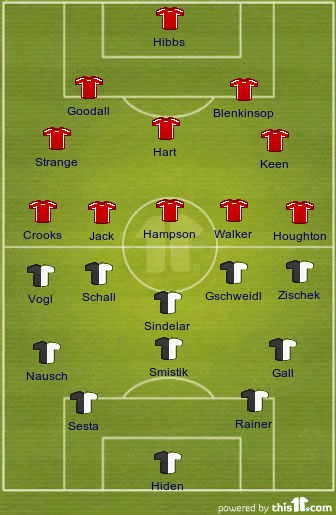


Formations for England (above) v. Austria
 With huge expectations of an historic encounter between two sides with claims to be the continent’s finest teams, 40,000 packed in to Stamford Bridge. The familiar nerves that plagued foreign sides playing in England were evident in the early stages as Hiden gave away a needless corner which Jimmy Hampson turned in after just five minutes. Twenty minutes later the Blackpool man scored again with an effort from distance. Austria found themselves 2-0 down, yet they dominated possession and left England unable to win back the ball.

In the second-half the Austrians again took charge of the game with controlled spells of possession football. Six minutes after the restart Austria pulled a goal back as Sindelar and Schall exchanged passes before Karl Zischek, the outside-right, beat Harry Hibbs in the England goal. The crowd were in raptures as the visitors every move was greeted with cheers and applause for the way that the pulled the England defence from one side to the other. Austria thought they were level when Walter Nausch fired towards goal, only to be denied by the upright.

Yet despite their superiority Austria could not make their possession count, and soon after pulling one back they found themselves further behind. Eric Houghton, England’s outside-left, aimed a free-kick at goal but the cruel deflection off Karl Sesta took it away from Hiden and into the net. Austria rallied through the brilliant Matthias Sindelar, but David Jack’s clever pass put through Sammy Crooks to score and England were out of sight. A late goal from Zischek made the score 4-3, but Austria could not force another and went away bitterly disappointed at their defeat.

The English press was in no doubt about who had been the better team. The Austrians were commonly regarded as the moral victors, while England were lucky to have scraped a win from a game in which they had been utterly outplayed. The game was described by the Daily Herald as “a most disturbing victory – the kind that leaves one wondering how it happened and a sort of creepy feeling that we were successful by the kindness of some spirit of chance which will never be so good again.” England’s famous home record was under increasing threat.

Friday, 15 July 2011

A History of World Football in 100 Games - Part 16

 England 7-1 Spain (9 December 1931) Highbury, London

Having suffered the ignominy of defeat in Barcelona at the hands of Spain in 1929, England were desperate to make amends when the two sides met in London in 1931. Spain were only the second team outside the Home Nations (after Belgium) afforded the chance to play an international on English soil, and hoped to do rather better that their predecessors who had twice been thrashed by a rampant England. Since their famous defeat in 1929 England had fallen again to Continental opposition, losing earlier in 1931 to France in Paris though they had not been able to field their first choice XI.

However, the new season had seen improved form for England. In the opening games of the Home Championship they had comprehensively defeated Ireland 6-2 in Belfast before easing past Wales at Anfield. England had also at last found a solution to the problems they faced in goal. Ever since the departure of the great Sam Hardy (who dominated the position from 1907-1920) England had tried a succession of men in goal, with nobody able to make the position his own. Harry Hibbs of Birmingham City had made his debut against Wales in 1929 and immediately showed that he was the man for the job. England’s long search for a goalkeeper was over.

Harry Hibbs

Spain had continued their own impressive form since the victory over England. The intervening years had seen them pick up victories over Italy, Yugoslavia and Portugal, with just one defeat to Czechoslovakia in Prague to mar their record. They did though have to make some late adjustments to their team for the game at Highbury.

Right-back Ciriaco Errasti had established himself as the first choice right-back for Spain but he was ruled out and was replaced by Ramon Zabalo of Barcelona, a man born in South Shields in the North-East of England but of Catalan ancestry. This change broke up the club partnership between Errasti and Jacinto Quincoces who played together at Real Madrid, but Zabalo was a capable replacement. Arguably of greater significance was the loss of inside forward Luis Regueiro, also of Real Madrid, which prompted a reorganisation in the midfield with Leonardo Cilaurren coming into the team.

The greatest challenge that the Spaniards faced though was psychological. As Willy Meisl wrote in his “Soccer Revolution”, “What the English could not know was the incredible inferiority complex under which these early Continental sides laboured when they stepped on to a British football field. For them it was sacred soil. They were so over-awed they hardly dared to put a foot down. If they were hit by an early goal, let alone by a couple, their strained nerves were shattered and they were beaten before they had a chance to get going.”

Sadly for Spain exactly that happened. With only four minutes gone they already found themselves two down. Jack Smith of Portsmouth put England ahead almost immediately after kick-off from an Alfred Strange pass, while Tommy Johnson doubled the advantage minutes later with a tap in. Meanwhile, thousands were still locked outside a bursting Highbury, with a capacity of only 55,000 preventing many more enjoying the slaughter.

T
he Spaniards struggled to get to grips with either the pitch or the physicality of the England players. The turf at Highbury was soft from the rain and gave easily underfoot. Furthermore Spain didn’t seem accustomed to the direct style of the English side, while their lack of pressing allowed the home team to dictate play at will. When they did get the ball the Spanish attempted to dribble, but found themselves the targets of some hard tackling from the English half-backs.

England went further ahead before half-time when Smith rifled a powerful shot into the roof of the net after receiving the ball from Dixie Dean. Spain stood little chance of recovering, but they had found themselves in a similar position in 1929 and had come back to win. Could they repeat the feat?

Any faint hopes that remained among the Spaniards were soon extinguished in the second-half. Two minutes after the interval Ellis Rimmer’s cross was met by Sammy Crooks who floated the ball over the head of a stranded Zamora. Crooks was the stand out performer in the second-half with his relentless dribbling running the Spanish half-backs ragged. It was from a Crooks corner that Dean scored the fifth goal of the game and the Everton striker soon turned provider when he laid the ball off to Johnson for England’s sixth after a Spanish handball.

Sammy Crooks
 Late on Crooks pounced on another sweeping crossfield pass from Rimmer to score England’s seventh, but Spain did have time for some consolation. Gorostiza, the Spanish outside-left who was known as the “red bullet” on account of his flame coloured hair and thunderous shooting, broke away and, true to his name, hit a powerful strike that Hibbs could not keep out. It was no more than Spain deserved.

The real impact of the game was restore the façade of England’s invincibility. It was clear to the fans at home that the defeat of 1929 (as well as the loss against France earlier in the year) was an aberration, a fluke result caused by the heat and the absence of England’s best players. In reality the scoreline flattered the home team, and they benefitted significantly from the soft turf and wet conditions.

Where England won the game was in their experience in dealing with such conditions and a willingness to play to their strengths. While Spain attempted to stick to their natural game of passing and dribbling the English backs were content to pump the ball forward for the strikers to chase. The ease of the victory only reinforced the view that the English style of play was the only way to go. On the Continent however, new ideas were being embraced which would challenge the pre-eminence the game’s inventors still enjoyed.

Friday, 8 July 2011

A History of World Football in 100 Games - Part 15

 Uruguay 4-2 Argentina (30 July 1930) Estadio Centenario, Montevideo


The first World Cup produced the final that all neutrals had hoped for. A repeat of the 1928 Olympic final pitted the two great South American rivals against each other again to decide which nation would enjoy international bragging rights for the next four years. Despite relatively slow starts from both sides in the group stage, the semi-finals had illustrated quite how strong each side was and the symmetry of their 6-1 wins in the previous game only showed how well matched the two sides were.

For their victory over the USA in the semi-finals, Argentina had enjoyed the passionate support of the Uruguayan crowd angered by the perceived arrogance of the North Americans. Any hopes that this positive atmosphere would continue in the final were clearly pipe dreams as traditional service was resumed between these two most bitter rivals. Neither side could contemplate losing at this stage, especially not to such a hated enemy.

If they could not rely on support from the home fans the Argentines did at least have their own countrymen to call on. The Argentines had chartered ten packet ships to transport their supporters across the River Plate, but the fans who gathered in Buenos Aires demanded still more. The crowds saw off these ships by chanting “Argentina si! Uruguay no! Victory or death” in an effort to pass on their own passion to the players charged with bringing back the World Cup. As it was the Argentine flotilla hit a snag when heavy fog descended on the River Plate and left thousands stranded on board ships with no hope of reaching Uruguay in time.

Those who did arrive were faced with suspicion by their Uruguayan hosts, almost like an invading army come to challenge the Celestes in their own arena. The Argentine supporters were searched for revolvers both on docking in Montevideo and on arrival at the Centenario as police feared for the security of the game. They were not the only ones nervous about the potential for violence. Referee John Langenus of Belgium insisted on life insurance prior to the game, such was his concern for his own personal safety. He also took the unusual precaution of having a pre-planned escape route to a waiting ship in the event that trouble might escalate.

1930 World Cup Poster
In fairness to Langenus there was genuine cause for concern that violence might break out between the supporters of the two nations. The disgraceful scenes that had taken place in 1924 when Argentina faced the newly crowned Olympic champions in Buenos Aires, had forced both the initial encounter and the replay to be abandoned due to crowd trouble. A repeat of such circumstances would have been a disaster for the organisers and all parties were keen to avoid such an embarrassment. Luis Monti, Argentina’s bulldog centre-half, had been the subject of death threats in the build up to the final in the hope that it might unsettle the visitors’ influential midfielder. Furthermore the decision was taken to reduce the capacity of the ground to just 80,000 in the hope that the issues of overcrowding could be avoided.

The first challenge that referee Langenus faced was to select a ball. Somewhat predictably both sides wanted a ball of their own manufacture, but Langenus immediately demonstrated the diplomacy which had made him an ideal choice for the final. It was agreed that Argentina’s ball would be used in the first half and the Uruguayan ball for the second. Each ball had its own characteristics, with the Uruguayan ball larger and heavier than its Argentine counterpart. The mind games clearly started early.

The two sides were almost unchanged from the semi-finals with Uruguay bringing back Castro in place of the ill Anselmo, while Argentina had Varallo returning from injury to reclaim his place from Scopelli and Suarez standing in for Orlandini. The Argentines had been forced to play one more game than their hosts, but had rotated their squad sensibly and so could have little grounds for any fatigue. A game of this magnitude could motivate even the most tired of players.


Uruguay (below) v. Argentina formations
The sides emerged to a rapturous welcome from a crowd eager to see the game underway and to their delight it was the home side that made the brighter start. Within the opening minutes Uruguay took the lead despite the desperate defending of the Argentines. When Scarone’s shot was blocked by Paternoster the ball fell to Dorado who rifled the ball through the legs of Botasso and past the flailing leg of Evaristo who stood on the goal line. The crowd’s roar of approval was as loud as any the new stadium would ever hear and put the Argentines squarely on the backfoot.

Minutes later though the tide had turned in favour of Argentina as they levelled the game with an excellently worked goal. Ferreira set Peucelle free down the right flank and with a moment of skill he skipped past Gestido, surged into the penalty area and thrashed the ball past Ballesteros to restore parity. It was a fine response to the Uruguayan opener and signalled that the Argentines were more than ready for the fight.

Before half-time Argentina took a shock lead when Stabile latched on to a hopeful cross from Ferreira and tucked the ball calmly past keeper Ballesteros. Varallo had given a smart pass to the Argentine skipper and sprinted into the box to get on the end of the return ball only for Stabile to bundle him out of the way to net for the Argentines. Such was the desire of the Argentine players that they were even prepared to ”foul” their own teammates in order to score. The Uruguayans complained vehemently to Langenus that both Ferreira and Stabile had been caught offside in the move, but the linesman failed to spot the infringement and allowed the goal to stand. Given the Uruguayans’ good fortune in the semi-final they could hardly complain about the disputed goal, but their vociferous protests were joined by those of the massed crowds inside the Centenario.

So disgruntled was Uruguayan captain Jose Nasazzi that he continued his discussions with Langenus into the half-time break, even following the Belgian into his dressing room to harangue the unfortunate official still further. Legend has it that Nasazzi scrawled a diagram of the contentious offside in the walls of the referee’s changing room and that it remained in place for many years in honour to this “national treasure.” Regardless the goal stood and the Uruguayans faced an uphill battle in the  second half as they sought to come from behind to win.

Early in the second half the Argentines had an opportunity to stretch their lead further as Stabile found himself one on one with Ballesteros only to miss-fire at the vital moment. Uruguay beathed a collective sigh of relief at the failure of the Huracan hitman to take this golden chance, but they still trailed and needed a goal of their own to get back on level terms. It came from a set piece as Fernandez, whose clever free-kick had undone Yugoslavia, swung another into the box towards Castro. He in turn fed Scarone who lofted the ball over defender Della Torre and into the path of Cea to finish the move off and bring the sides level again.

They would not stay tied for long as Uruguay, clearly lifted by their second score swarmed towards the Argentine goal. Luis Monti who had been so influential in the earlier games appeared unsettled by the alleged death threats he had received and failed to impose himself on the game. Instead it was the trio of Andrade, Fernandez and Gestido who yet again orchestrated the Uruguayan attacks. Scarone and Cea among the forwards looked the most dangerous though Petrone was out of sorts and had little impact on the game.

When the goal came it was one to savour as Iriarte received a long punt forward from Mascheroni and blasted the ball past an outstretched Botasso. Juan Evaristo had attempted to block the Uruguayan winger’s venomous shot, but despite his close marking the ball flew into the Argentine net. Finally Uruguay had recaptured the lead and from now they seemed desperate not to give it up. That’s not to say however, that they did not face scares before the game’s end. First Stabile and then Varallo rattled the frame of the Uruguayan goal, but it appeared that the footballing gods were smiling on Uruguay that day.

Soon after, Varallo’s knee injury reduced his impact and he was forced to the wing as Argentina reshuffled their pack in an attempt to steal an equaliser. They had faced a daunting task when playing with eleven fit men, but with ten the Argentines stood little chance. Soon after the Uruguayans applied the coup de grace as Dorado crossed for Castro to head past Botasso despite the intervention of Della Torre. The one armed forward settled any argument and sealed the victory for Uruguay, a magnificent victory for the hosts.


Uruguayan celebrations
In the aftermath of the game Varallo’s father was forced to sneak out of the stadium draped in a Uruguayan flag to avoid being recognised as an Argentine in such a charged atmosphere. Back in Buenos Aires the reaction was no less measured, as fans pelted the Uruguayan consulate with stones and were only forced to disperse when the security forces opened fire. On a footballing level the Copa America was not played for another five years (though this was in part due to the  internal schisms which arose in both countries over the issue of amateurism) and the two sides would not meet again in any competition until 1932.

Uruguay had proved beyond doubt that not only were they capable of producing a world class team, but they were also able to host the game’s biggest event. Of course a number of administrative hiccups had arisen over the course of the inaugural World Cup, but that was to be expected given the scale of the undertaking and the novelty of the tournament. The World Cup had undoubtedly been a significant success, with the festival even making a modest profit. The gamble of awarding the tournament to Uruguay ahead of the more established powers had paid off and despite the indifference of most of Europe towards the competition there was no doubt that the experiment would be repeated.

Thursday, 30 June 2011

A History of World Football in 100 Games - Part 14

France 4-1 Mexico (13 July 1930) Estadio Pocitos, Montevideo

As early as 1902 there were thoughts of creating a global football tournament. Dutch administrator C.A.W. Hirschmann approached the FA in that year with plans for a new competition and with it a new governing body, but was met with a lack of interest in his proposals. Frenchman Robert Guerin had similar thoughts, but such was the seeming futility of his attempts to convince the FA that he described the process as like “trying to slice water with a knife.”

Following discussions with the leading administrator in Belgium, Guerin invited representatives from the continent’s leading nations to meet in Paris on 21 May1904 with a view to the formation of the grouping he so craved. At the headquarters of the Union Française de Sports Athlétiques at 229 Rue Saint Honoré a historic gathering took place which saw the birth of what would become the most powerful sporting body in the world. The men that attended that first meeting were to participate in the creation of the Fédération Internationale de Football Association (FIFA).


Robert Guerin

While FIFA demonstrated immense ambition in its early years, it managed to achieve very little. A proposed European championship, to be held in Berne in 1906, came to nought, and it seemed for a time that FIFA would lack any obvious purpose. It was only with the success of football at the Olympics in the 1920s that a large scale football completion became viable. Football accounted for a third of all revenues generated by the 1924 Olympics in Paris showing that the tournament could be self-supporting.

At a meeting with Enrique Buero of Uruguay in Geneva in 1926, FIFA President, Jules Rimet, had conceded his interest in the foundation of a World Cup, but no firm commitment was made. In 1927 FIFA set up a special commission to discuss the potential for such a tournament, and at the FIFA Congress of 1928 in Amsterdam the decision was made to hold a World Cup in 1930. While a host of European candidates were ready to host the tournament, the decision was taken to award it to Uruguay on account of their recent Olympic success, the centenary of their constitution and their willingness to build a stadium fit to host the inaugural World Cup.


The Jules Rimet Trophy
 Following frantic preparations the tournament began in July 1930, though the promised stadium was not ready for the early games and the opening ceremony took place after Belgium, Bolivia, Brazil, Mexico and Paraguay had all been eliminated. While the European teams had been willing to host the tournament, rather less had been willing to travel to Uruguay and as such it was a tournament with only 13 teams.

The opening game (along with Belgium against the USA) saw France take on Mexico. The game was played in conditions which certainly suited the French over their Aztec adversaries. It had snowed in the night before the game and as a consequence the playing surface was something of a quagmire which stifled flowing football.

France made much the brighter start of the two teams, full of vigour and invention, and the Mexicans were forced to defend in the early stages of the game. After nineteen minutes the French made their pressure count, breaking the deadlock and with it scoring the first ever World Cup goal. The man with that great honour was inside-left, Lucien Laurent. Andre Maschinot played the ball out to Ernest Liberati on the right flank and his cross was met by Laurent to volley home and put the French in front.


Lucien Laurent

Yet just as the French appeared to have settled their nerves they suffered a significant set back. Goalkeeper Alexis Thepot suffered a boot to the head, sustained in a clash with Mejia and had to leave the field. At the time no substitutions were permitted and so left-half Augustin Chantrel was forced to take over in goal and the French were forced to play with just ten men with over an hour remaining.

Les Bleus’ ability to weather the storm of losing their keeper owed as much to Mexico’s inability to impose themselves on the game, as France’s own mental strength. Just ten minutes after going a man down the French extended their well deserved lead. Etienne Mattler, the French right-back, centred for Marcel Langiller to put them two goals ahead. Within two minutes Oscar Bonfiglio, the Mexican keeper, found himself picking the ball out of the net for a third time when Maschinot finished off after some excellent work from Delfour created a shooting chance.
    
At half-time the Mexicans must have feared for a repeat of their last appearance in a major tournament, when they suffered a 7:1 annihilation at the hands of Spain in the 1928 Olympics. Yet their performance in the second half showed that the side did at least possess spirit.

The words of coach Juan Luque de Serralongo had the stirring effect desired and the Mexicans began to master the trying conditions. With twenty minutes remaining they got their reward, when Dionsio Mejia fed Juan Carreno and he crashed the ball past stand-in keeper Chantrel. The Mexicans poured forward in the last twenty minutes in a desperate attempt to get back into the game, but they were unable to unlock a well drilled French defence.

Almost inevitably, the Mexicans’ desire to level the scores gave the French the chance to put the result beyond doubt. With just three minutes remaining the French broke swiftly through Marcel Langiller and his pass allowed Maschinot to wrap up proceedings with a calm finish. France, on the eve of Bastille Day, had looked impressive, but it was clear that they would have to improve again with far stiffer opposition to be faced in their remaining games.

Thursday, 23 June 2011

A History of World Football in 100 Games - Part 13

Arsenal 2-0 Huddersfield Town (26 April 1930) Wembley, London


After the goal rush that had followed the 1925 amendment to the offside law, it was inevitable that somebody would plot a way to counteract the sudden increase in scoring. The offside trap which had been so expertly laid by McCracken and Hudspeth of Newcastle, was no longer the effective tool it had been. With just two full-backs facing five forwards, the balance of power had shifted firmly in favour of the attack, now someone needed to swing it back.

Herbert Chapman was the greatest manager of his day. At Huddersfield he had created a team which would win 3 league titles in a row, with a system which seemed to run counter to all footballing orthodoxies. In the past the league’s best teams had been those who enjoyed the majority of possession and made this pressure count by converting it into goals. Chapman turned this thinking on its head and became the first manager to use counter-attacking as a genuine strategy rather than a mere response. Chapman’s Huddersfield would defend deep and then launch quick counter attacks, before their opponents could reorganise their own defence.

In 1925 Chapman accepted the chance to move south and manage an Arsenal team who were less than successful at the time. In exchange for leaving the best team in the country Chapman requested full control of the team and warned chairman Henry Norris that he would not win anything for 5 years. Chapman’s pedigree forced the normally overbearing Norris to agree, and there began the beginnings of Arsenal’s success.


Herbert Chapman

Chapman’s first signing at Arsenal was the great Sunderland inside-forward Charlie Buchan, a man who himself had a definite opinion on the impact of the new offside Law. What Buchan realised was that to combat the new Law it would be necessary to move the centre-half into defence and slot him between the two fullbacks. This new centre-back would provide much greater cover for the full-backs and give the team a stronger base from which to build. If Chapman was to continue his counter attacking policy it would be necessary to have a strong defence on which to base it.

The WM system (named after the pattern that the players took on the pitch) though did not see just one radical change, but two. In order to make up for the loss of creativity suffered by the withdrawal of the centre-half, it was necessary to force one of the inside-forwards deeper to link the play between defence and attack. Buchan himself was too valuable a goalscorer to allow to play in such a deep position, so at first Chapman tried Andy Neil in the role with significant success. It was in 1928 though and with the arrival of Alex James from Preston that the withdrawn inside-forward really came alive.

By 1930 the system was fully evolved, and it marked some radical changes for each position. With the arrival of the centre-back he was now charged with marking the opposing centre-forward, the full-backs now marked the opposing wingers, while the wing-halves would mark the inside forwards. For Arsenal, both inside-forwards were now playing in deep positions as David Jack arrived to play alongside Alex James.


Arsenal (below) v. Huddersfield

In the 1930 FA Cup final Chapman’s Arsenal faced his old club Huddersfield, looking to lift the FA Cup for the first time. Having travelled to Wembley for the 1927 final, only to lose 1-0 to Cardiff City, the Arsenal players were determined to make amends for past failures. Their route to the final had been a gruelling one, with replays required to overcome both Birmingham and Hull, but they arrived at Wembley fresh and ready for battle. Neither team had enjoyed a vintage league season, with Huddersfield finishing tenth and Arsenal fourteenth. As such Huddersfield were a far cry from the dominant force of the early 20s, who had won three titles in such style.

For the first time in a Cup final the two sides entered the pitch side by side, with Tom Parker and Tom Wilson leading out their respective teams. Parity between the two teams did not last long in the match though as Arsenal took an early lead. In the sixteenth minute Arsenal won a free-kick which Alex James took quickly by passing the ball to winger Cliff Bastin, the ball was played back to James who hit a fierce drive into the corner of the net from the edge of the area. It was a pre-planned move that James had thought out with Bastin prior to the match, and the quick thinking left Huddersfield standing still.

It was shortly after this in the first-half that the final had a surprise visitor. The German Graf Zeppelin, the world’s largest airship, emerged over Wembley and drew the crowd’s attention from the match. Huddersfield’s manager, Clem Stephenson, had been aware of the planned appearance prior to the match and had protested but been ignored. It could at least be said that the distraction applied equally to both teams.


The Graf Zeppelin looms over Wembley


Having taken the lead Arsenal found themselves primarily focused on defence in the remainder of the first half. Attacking mainly down the flanks Huddersfield enjoyed plenty of the ball and used the pace of their wide players to frighten the Arsenal full-backs. However, this good work from Alex Jackson and Billy Smith was not matched by the inside-forwards and so attacks broke down with little threat to the Arsenal goal.

In the second-half Huddersfield again pressed and looked by far the likelier side to score. They lacked though some of the control they had enjoyed in the first-half and the game was far more frantic with an ebb and flow which stopped either side enjoying long spells with the ball. Charlie Preedy, for Arsenal, was by far the busier of the two keepers and he rode his luck at times as he split the ball, only for a team mate to hack it away.

In the dying minutes of the game James sprayed a long pass out of his own half to find Jack Lambert, Arsenal’s centre-forward. Lambert eluded Goodall and Spence before firing a powerful shot past a static Turner in the Huddersfield goal. At 2-0 Huddersfield lost their momentum and lacked the urgency they had shown throughout the second-half. Arsenal had finally brought home some silverware and Chapman’s prediction of winning a trophy after 5 years had come true.

Tuesday, 14 June 2011

A History of World Football in 100 Games - Part 12

Spain 4-3 England (15 May 1929) Estadio Metropolitano, Madrid

The performance of the Wembley Wizards in 1928 may have demonstrated a vulnerability within the England team, but against Continental opposition they remained preeminent. In over twenty games against teams from outside the British Isles England had never failed to win, and usually did so by a large margin. As such their tour of the Continent in 1929 could be regarded as something of a holiday.

In fairness the tour pitted them against some of the finest sides in Western Europe of the time. They started against France who they beat 4-1, with Edgar Kail and George Camsell both scoring doubles in an easy victory. Next were Belgium, the 1920 Olympic champions, and they too were brushed aside with a resounding 5-1 scoreline. Camsell scored 4 in the game, but suffered an injury that ruled him out of the final game of the tour.


George Camsell
 That match was against Spain, who had shown themselves to be a coming power of European football. After finishing second to the Belgians at the 1920 Olympics, they had demonstrated significant promise with multiple victories over France and Portugal. The arrival of professionalism in 1926 had given the Spaniards greater motivation to hone their skills and they proceeded to improve still further. In the months before facing England the Spanish had beaten Portugal 5-0 and France 8-1 to show the extent of their rise.

It was little wonder then that the home crowd was expectant, but the mile long queue which formed over four hours before the game for a chance to witness the game marked out the Spanish as fanatical supporters of football. The sweltering heat of a sunny May afternoon in Madrid coupled with the volume of fans provided an intimidating welcome for the visitors

England kicked off but soon found themselves on the back foot. Severino Goiburu, the only Spanish player who was not professional, received the ball from Gaspar Rubio and set off on a mazy dribble which ended with a shot flying narrowly over the bar. Mariano Yurrita, the Spanish left-winger, was the next to go close with a drive which went narrowly wide. It was not long though before England imposed themselves on the game.

With 19 minutes gone Hugh Adcock of Leicester City dribbled past a series of Spanish opponents before cutting back a cross for Joe Carter to start the scoring. Minutes later the two players combined again, with Carter beating Zamora to double the English advantage. At half-time and 2-0 up, England appeared to be in full control.

It did not take the Spaniards long to get back into the match. Just minutes after the interval Jose Maria Pena crossed for Rubio to head past Hufton and start the comeback. Now England were on the back foot and the Spanish capitalised on it when their outside-right, Jaime Lazcano, cut in from his wing and struck a rocket of a shot which flew past Hufton. The two  sides then took it in turns to attack with Hufton foiling Goiburu before Zamora turned away venomous efforts from Hill and Barry.


Ricardo Zamora
 England began to reassert themselves in the middle of the second-half and forced a series of corners but were unable to take advantage. Finally England’s dominance paid off as Jack Hill was put though and he beat Ricardo Zamora to restore England’s slender advantage. The searing heat took its toll on England in the latter stages of the game as they were just desperate to hold on. The Spanish appeared by far the fresher team and Lazcano drew them level with only minutes remaining. Almost immediately from the restart Goiburu charged forward and beat Hufton with a powerful shot that flew in at the near post.

As against Scotland at Wembley, England’s half-backs struggled to cope in Madrid. Martin Marculeta dominated the middle of the field and was a constant hindrance to England’s passing game. Up front Adcock and Carter impressed, but the team missed Camsell whose ability to lead the line and unsettle opposing defences counted for so much. Edgar Kail, who had so impressed against France, was largely a passenger though his presence should be noted as the last time a non-league amateur ever played for England.

The crowd had burst onto the pitch following Laczano’s equaliser, but following the final whistle the stadium descended into chaos. Such was the excitement of the crowd and their desire to celebrate with their heroes that the Civil Guard were required to escort the players from the pitch. England’s invincible record in Europe was over.

Wednesday, 8 June 2011

A History of World Football in 100 Games - Part 11

 Everton 3-3 Arsenal (5 May 1928) Goodison Park, Liverpool


Of all the many footballing records that might never be broken, few look more untouchable than that of Dixie Dean. His goalscoring exploits of 1927-8, when he scored an astonishing 60 goals in the league alone, look set to remain in the history books for many years to come. They were indeed so great that Bill Shankly, not noted for his enthusiastic support for the blue half of Merseyside, once said “Dixie was the greatest centre forward there will ever be. His record of goalscoring is the most amazing thing under the sun.”

At the start of the season Everton fans had limited cause for optimism. The previous year they had finished third from bottom (the bottom two being relegated), with only four points sparing them from the drop. They did though have, in Dean, a frontman who had already proven his potency at the highest level. Since his move from Tranmere in 1925 for a fee of £3,000 he had never stopped scoring. 32 goals in 38 games in his first full season at Goodison had been followed by 21 in 27 in his second, but few could predict quite how prolific Dean would be in 1927-8.

In 1925 the landscape of the game was radically altered as a result of the change in the offside law. The early years of the twentieth century had seen the beginnings of more cunning defensive practices. While the game’s nascent years had seen frequent offside calls that had been an unintended consequence of the first laws of the game these faults had been quickly modified to prevent the excessive break down of attacks. However, as time went on, some defenders realised that by clever use of the offside rule they could cut out significant numbers of attacks before they even started. The first team to use effectively the offside trap were Notts County (the oldest surviving league club) whose fullbacks Jock Montgomery and Herbert Morley would cleverly step up at the crucial moment to leave the opposing forwards offside.

The technique was perfected by Newcastle though and particularly defenders Bill McCracken and Frank Hudspeth. Such was the renown of the Newcastle offside trap that “legend has it, that when one team arrived at Newcastle central station and the guard blew his whistle the team’s centre-forward quipped: ‘Blimey, offside already!’” However, so effective was this tactic that it began to ruin the game as with only two defenders it was too easy for attacks to be stopped with an offside call. As such the decision was taken in 1925 to amend the offside law, so that only two defenders (including the goalkeeper) needed to be between an attacker and the opposing goal.

The result of this change in the years that followed was a boom in goalscoring numbers as defences struggled to adapt to the new system. The first man to take real advantage of the change in the laws and the resulting confusion was George Camsell. Playing for second division Middlesbrough, Camsell struck an amazing 59 league goals in the 1926-7 to secure promotion for the Teeside club.


Dean started the 1927-8 by scoring Everton’s fourth in a rout of Sheffield Wednesday and never stopped from that point on. After his first 9 games he had already notched 17 goals, netting in every one of those games and scoring all Everton’s goals in a 5-2 demolition of Manchester United. In April Dean equalled the top flight goalscoring record, set by Ted Harper of Blackburn in 1925-6, when he scored his 43rd goal of the campaign in a 3-3 draw at Anfield.

Going into final games of the season the record appeared to be beyond Dean. With 4 games remaining in the season he was on 50 goals in 35 games. Even at his incredible strike rate this appeared to be asking too much. A single goal in a win over Newcastle helped Everton’s title chances but appeared to hurt his hopes of the record. Dean followed that with a brace in a 3-2 victory over Aston Villa to leave him needing 7 in his last 2 games. The first of those came against Burnley where he was marked by England captain Jack Hill. Despite the attentions of his national team colleague Dean was unaffected and scored 4 before half time, before having to be withdrawn with a leg injury.

That victory clinched the title for Everton with Huddersfield, their nearest rivals, imploding in the final weeks of the season. The injury to Dean though threatened his hopes of surpassing Camsell in the final game of an amazing season. Their opponents Arsenal were already assured of their top flight status and a midtable finish (an incredible closing table saw Spurs relegated on 38 points while Arsenal finished tenth out of 22 teams with just 41 points), so everyone arrived at Goodison in anticipation of Dixie Dean’s heroics. The fact that it was the final match for Charlie Buchan, one of the greatest forwards of the era, in a career spanning back to 1910 was forgotten in the excitement. All thoughts were purely on Dean and the record.      

The match did not start as the spectators had hoped though as within two minutes of the game starting Shaw scored for Arsenal with a powerful shot which Davies fumbled between his legs. This did not put Dean off his stride. His first was a powerful from the edge of the area after a corner from Critchley. Minutes later Dean was sent clean through on goal, only for Butler to bring him down from behind in the box. Dean naturally took the penalty himself and fired it between the keeper’s legs to put Everton ahead. With ten minutes remaining until half-time O’Donnell, the Everton full-back, put through his own net to level the scores at 2-2.

The atmosphere as the players emerged for the second-half was filled with anticipation. The Everton team were desperate to see Dean pass the record, while Arsenal defended doggedly to prevent them. At times Dean was surrounded by markers, intent on doing everything in their power to stop him scoring the vital goal. Despite their best efforts Everton simply couldn’t fashion a clear chance for Dean and were running out of time in which to do so. Patterson in the Arsenal goal was also keen to deny Dean tipping a number of speculative efforts around the post.

With five minutes remaining Patterson tipped a shot from George Martin over the bar, and Alec Troup raced over to take the corner. Dean positioned himself just outside the area as the corner was drifted in to the box before charging in with a ferocious header which left Patterson flatfooted. The crowd erupted with spectators bursting forward to congratulate Dean on his achievements. A late Arsenal equaliser from Shaw could not spoil the crowd’s mood and none could fail to marvel at the incredible achievement of the Everton striker. Since that day no player has ever come close to surpassing Dean’s record in the top flight and it is doubtful they ever will.